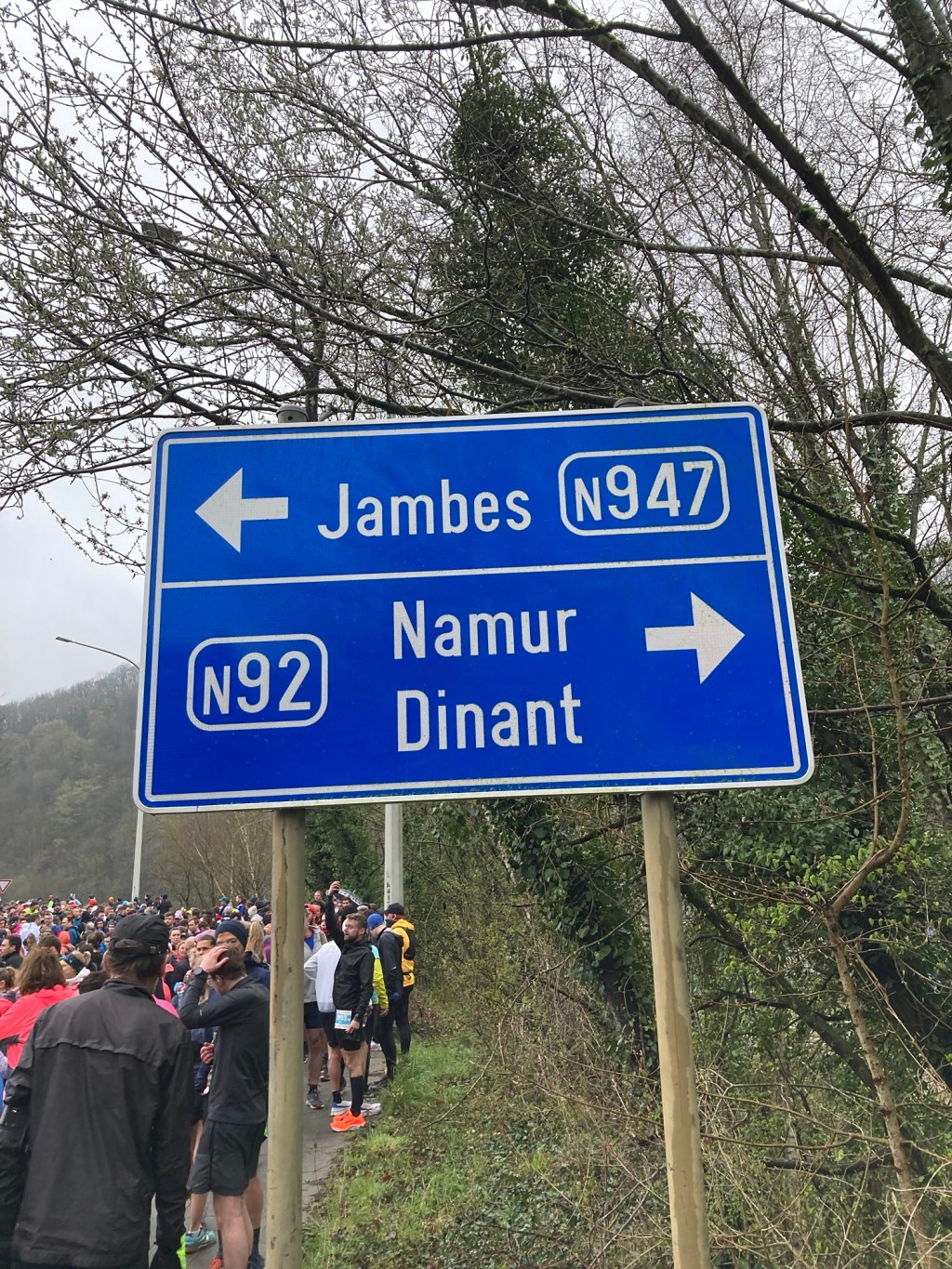
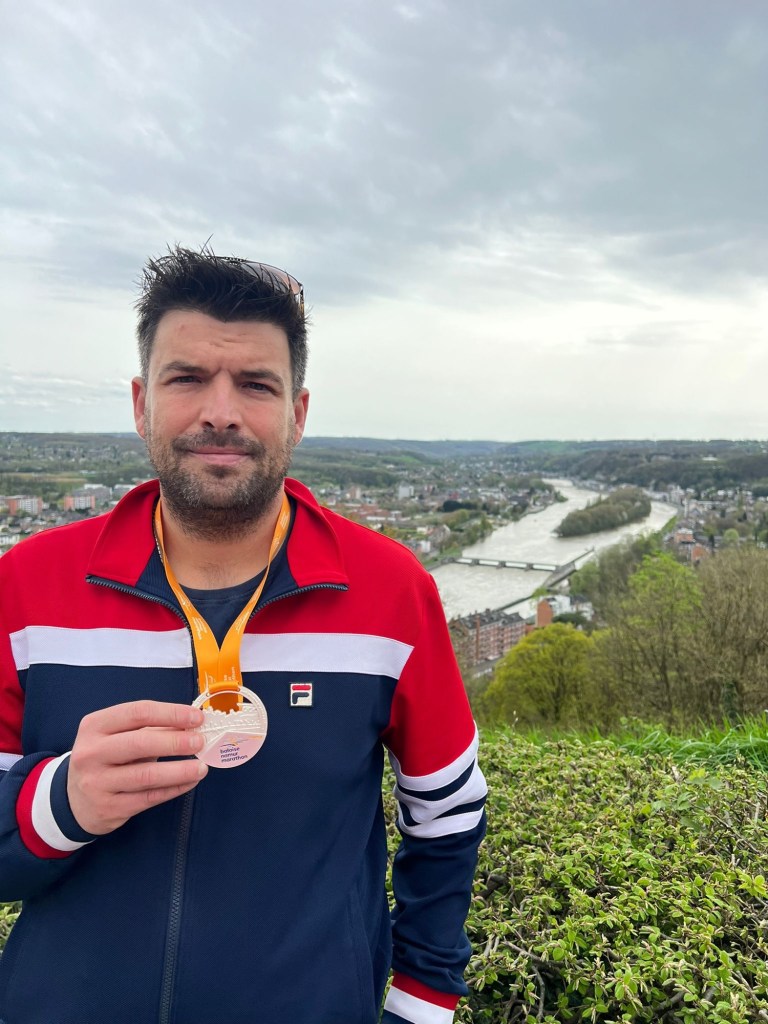
In April 2023 I paid my first visit to Namur, Belgium for the Namur Half Marathon. The old Belgian city is an iconic name in motocross, having served as the venue of the Belgian 500cc Motocross Grand Prix for many decades, as one of the sport’s most iconic race tracks.
Following my visit, I compiled an article with my thoughts of visiting the famous venue for the first time, and it was published later that year in the UK-based ‘DirtBike Rider / TMX News’ magazine.
Here is the article for your enjoyment. Some amendments have been made taking into account the time since I first wrote this article, but most of it still remains the same. Hope you enjoy it!
NAMUR REVISITED – Chris CZORA
For anyone with an addiction to motocross, one of the most common side-effects is the ability to dream of fantasy motocross tracks in the most unlikely of settings.
If driving along a country road, the undulating farmer’s fields that sweep by can easily be re-imagined as a championship standard track, with fans craning over the barriers as their heroes charge up the relentless hills. And if ever you’ve been to a suburban country park strolling around the attractive parkland, it’s easy to imagine a gnarly motocross course snaking through the trees, around the expensive townhouses and sweeping up and down through the woodlands.
Of course, the noise and disruption caused by a motocross meeting in such a semi-urban setting would render such a course as purely a flight of imagination. Right?
Well, in the case of one small Belgian city, such a course not only existed, but in its’ 60 year history became renowned as one of the most spectacular, unique, dangerous and downright bonkers Grand Prix circuits in the world. We’re talking about Namur of course.
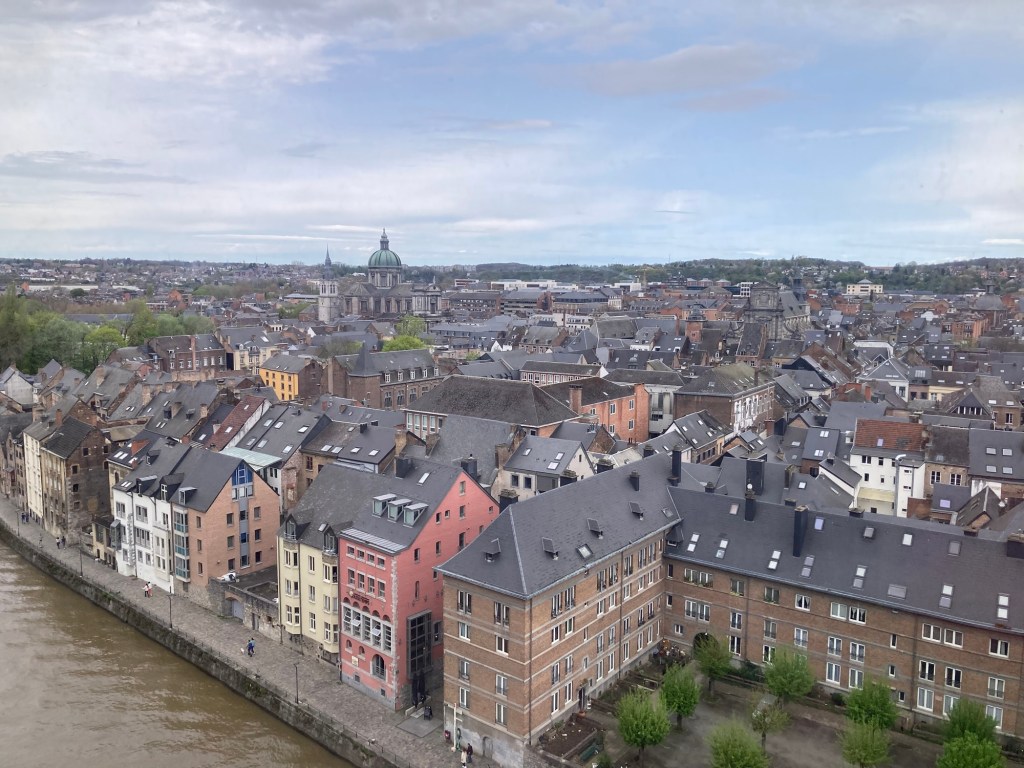
Nestled in the rolling countryside of central Belgium, Namur sits around one hour’s drive south-east of Brussels. It’s a charming, sleepy old city, dating back to Celtic times although recent archaeological work found evidence of Roman occupation. Geographically it sits at a confluence point of the Meuse and Sambre rivers, which cut through the city. Although an attractive place to be, it’s not really a major international tourist venue like Brussels, or the booze-cruise hotspot of Bruges a little further north. Wander through the city streets and the only language you’ll likely hear is French. However Namur is still a rather notable city.
Politically it serves as an important venue, with the parliament for the French-speaking Walloon Region of Belgium located alongside the banks of the Meuse. And just a little further up the road is the city’s most iconic landmark, the Citadel.
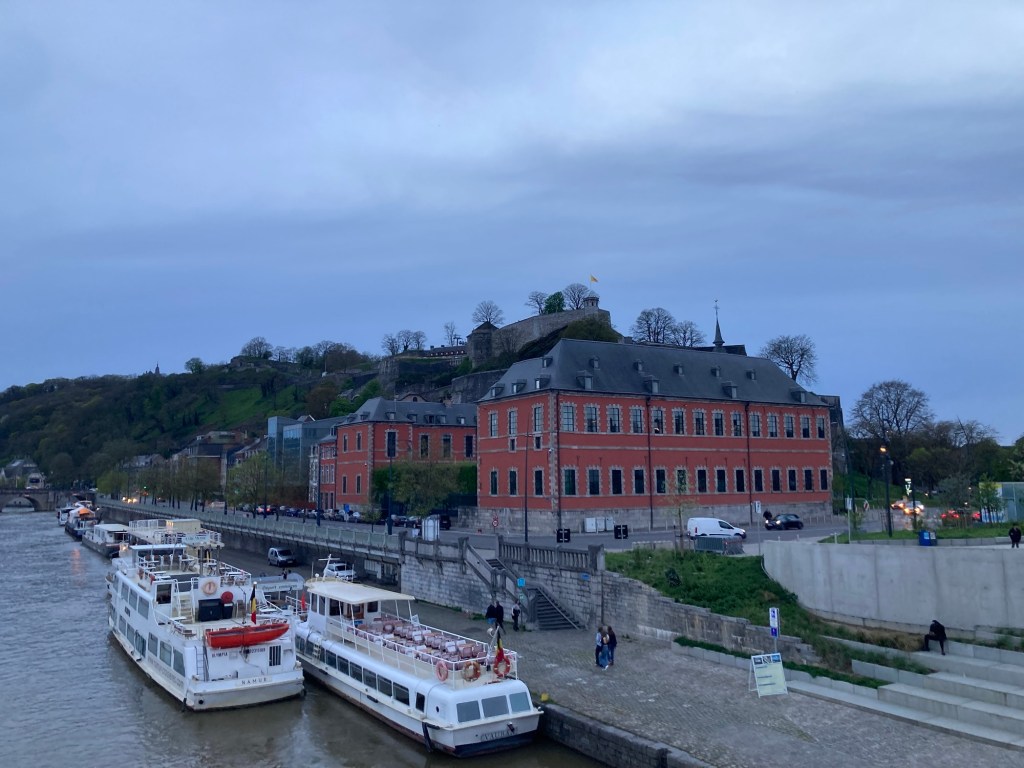
A steep, hilly outcrop sitting between the two rivers, as early as the Middle Ages a fortress was known to exist on the site. The citadel in its current form dates back to the 1600s with various additions and improvements added in the following centuries. Today it is a popular tourist attraction, and a fascinating voyage of discovery for those who visit.
To the rear of the fortress, the Citadel is made up of tree-lined hillsides, and along a network of twisty hillside roads, some of the most affluent housing in the city.
And it is of course on these hillsides that the motocross legend of Namur was born.
The Namur circuit pre-dated world championship motocross, with the first ‘Motocross de la Citadelle’ taking place in 1947. This followed a previous event at nearby Jambes in 1946, which proved to be so successful that a larger venue was immediately sought. It didn’t take too much imagination to look over the river at the imposing hillside fortress standing on the nearby riverbank, and think “that’ll do!”
The success of these early events led to European championship events being staged, along with the venue being selected to host the 1951 Motocross des Nations team event. The Belgian 500cc Grand Prix followed in the immediate few years.
Even in these immediate post-war years, contemporary circuit maps show a track layout that would be immediately recognisable to motocross fans of generations to follow. Whilst the exact layout would alter slightly in the circuit’s lifespan, even in the early days the essence of the track was there.
After a fast start on the top of the Citadel next to a huge grandstand, riders would spend large portions of the lap navigating a tight, hilly course through the trees on the Citadel hillside. The lap included fearsome charges through the woodlands dodging large trees, along with navigating slow, steep climbs that were virtually impossible to walk up. Conquer all that and the challenge wasn’t over, with the course including narrow woodland paths following hillside cuttings that had a sheer drop just a few inches to the side of the track, protected by flimsy fencing that looked in no way capable of stopping an out of control bike.
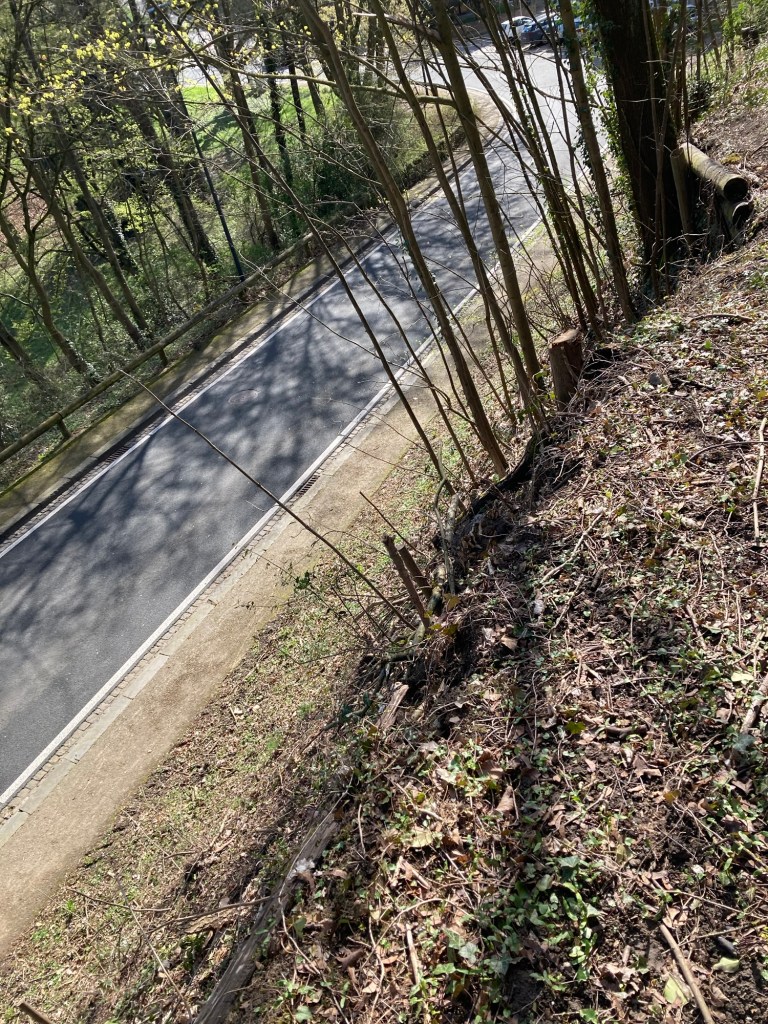
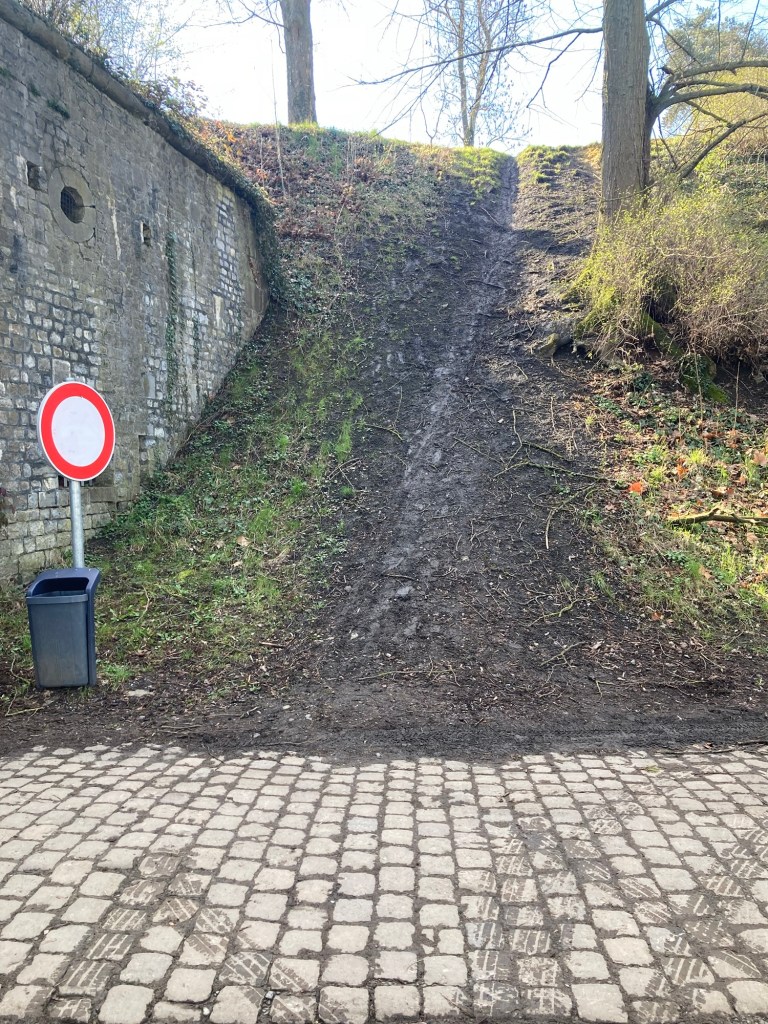
The course intertwined with some of the hillside roads that led from the city, but did that matter? No, a few hundred metres of tarmac and cobbled streets just added to the challenge. Margin for error was minimal, with huge trees and at one part of the lap, the external walls of the Citadel serving as an intimidating reminder not to get things wrong.
And of course, the spectators loved it, as generations of riders sought to conquer the Citadel.
The 1980s are often cited as a ‘golden era’ for Namur. As the 500cc bikes of the era grew ever more powerful and advanced, Namur’s reputation grew yet further as the circuit became increasingly obsolete.
Even by the 1980s, most Grand Prix circuits did not typically include the natural hazards that were inherent at the Citadel, which grew increasingly notorious. The circuit was even struck off the 500cc Grand Prix calendar for one year in 1984, failing the FIM homologation.
Namur was almost a second British Grand Prix. Only a few hours from the French ferry ports, fans who’d already whetted their appetite at the British Grand Prix at Farleigh Castle or Hawkstone would travel across to Belgium a few weeks later to soak up the carnival atmosphere and cheer on a strong legion of British riders, headed of course by Dave Thorpe, who more often than not was battling with the leading Belgian stars for world championship glory. Thorpe’s 1989 Belgian 500cc GP is one of his most iconic victories en route to his third world title, whilst three years later in 1992 Kurt Nicoll added his name to British winners, although he was to narrowly lose out on the title later in the season to the Belgian legend Georges Jobe.
Namur’s traditional date in early August meant it was often a venue where the titles were decided, 1988 being one of the most famous years in Namur’s history as Belgium’s Eric Geboers took his first 500cc world title, becoming the first rider in history to win the career clean sweep of 125, 250 and 500 titles. But even that was arguably not the talking point of the day. 1979 250cc and 1983 500cc world champion Hakan Carlqvist was having a fairly anonymous final Grand Prix season, but felt in good form going to Namur. Keeping his laptimes under the radar during practice, the Swedish hardman dominated proceedings to take victory, famously stopping at the roadside Chalet du Monument bar to grab a beer from his brother in the crowd, and take a few swigs before powering onto victory.
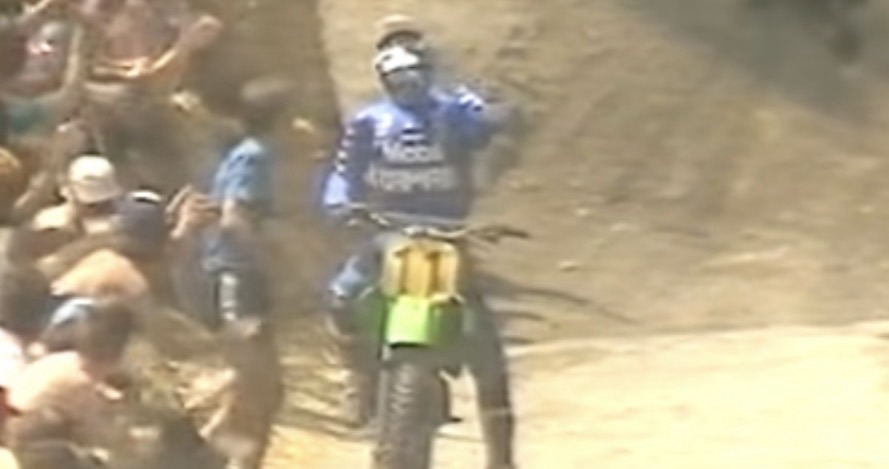
Beer of course was in strong supply. Off the track, the circuit had a festival atmosphere. Race fans would camp in the woods wherever a spot could be found, although this was later banned with fans having to camp several miles away out of town. The circuit’s famed road section saw fans pack out the roadside bar, climbing on the beer benches as their heroes raced past, resembling a two-wheeled Belgian version of a rowdy Oktoberfest bierkeller. This part of the circuit was certainly one of the most photogenic parts of the circuit as riders sped by on the tarmac road, with the cheering race fans within literal touching distance as they craned over the fences.
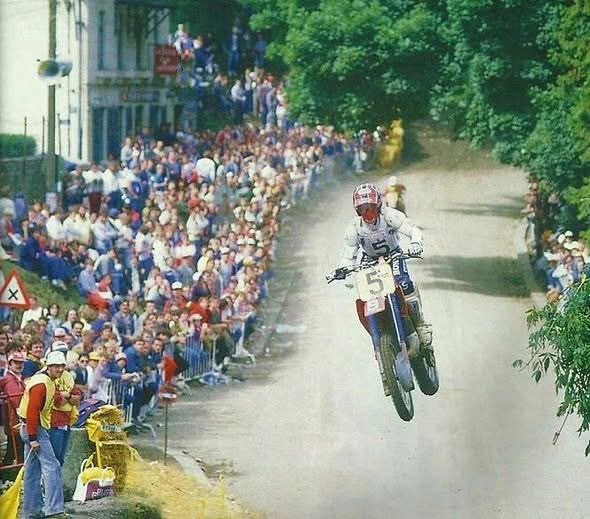
Whilst the festivities were usually good natured with ‘well-oiled’ fans enjoying the carnival race atmosphere, one or two less salubrious fans sometimes crossed the line. During the aforementioned 1989 Grand Prix, Dave Thorpe recalled in his later autobiography an incident with a race fan spraying a beer can at his face as he passed each lap, and after initially assuming it was a Belgian fan of rival Eric Geboers, after speaking to the Belgian champion, he’d had the exact same issue with the fan and assumed it had been a Brit!
A few years later in 1993, Georges Jobe, now retired and looking after his young protégé Gerald Delepine, took to the video cameras to complain about the attitude of some British fans, still resentful of Jobe’s title defeat of Kurt Nicoll in 1992, who threw beer cans at Delepine. Ever the diplomat though, Jobe said he ‘knew British fans were better than this’.
For the non-moto people reading this, I should clarify here that although Georges Jobe achieved title success at the expense of British riders, he was nonetheless loved by most Brits as much as the home heroes, his iconic mid-air pass of rival Andre Malherbe at the 1984 British Grand Prix saw him pass into legendary status, and he is still sadly missed by all following his tragically early passing from leukaemia in 2012.
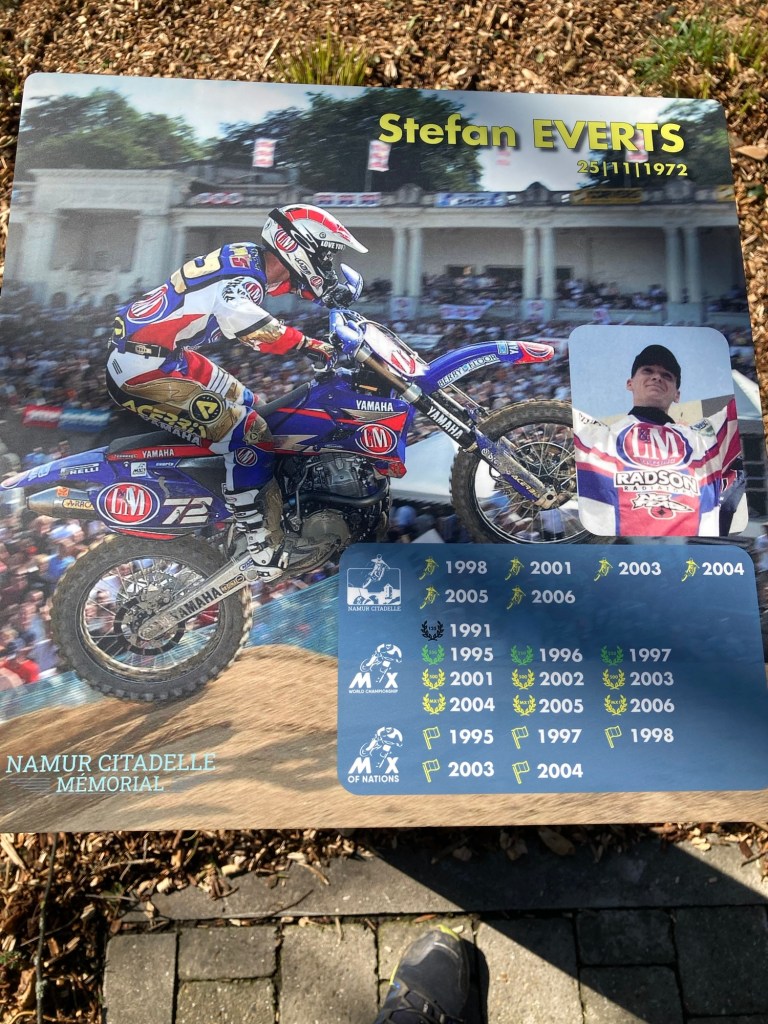
The 60 year history of the Citadel circuit was to end in 2007, just one year after Stefan Everts took his final Namur victory, cementing his name amongst the list of Belgian greats. By now, the TV-led era finally rendered the track unsuitable for modern motocross, organising races was becoming ever more difficult logistically and politically, and after Frenchman Sebastien Pourcel took the ‘MXGP’ class victory and Italian Davide Guarneri the smaller ‘MX2’ class, the engines fell silent. With the exception of a few historic parades the Citadel has remained silent ever since and will likely remain so.
I’d never been to Namur. I grew up in the late 80s watching 500cc VHS tapes, and even to the eyes of a youngster, the track looked incredible. Races started with spectators lined granstands, like some form of Roman colliseum. Then of course they were racing down a tarmac road, how mad was that?
It’s a race I’d always wanted to visit, but it passed me by. More fool me. Maybe I took it for granted, a circuit as iconic as Namur would surely be etched onto the calendar, the Monaco of motocross?
My inspiration for finally going to Namur came courtesy of ‘The Inside Line’ the excellent autobiography and time capsule journal from 1980s 500cc Grand Prix rider Rob Andrews. In the book, Rob diverts away from his Grand Prix tales to devote a chapter entirely to Namur, describing why it was so special from the eyes of someone who raced there. No-one had described it in such detail before, in particular his first impressions driving to the track. First seeming peculiar how close it was to the city, before the crazy nature of the venue slowly revealed itself as he and his mechanic got ever closer to the ‘paddock’ – which in itself was a large play area & town garden.
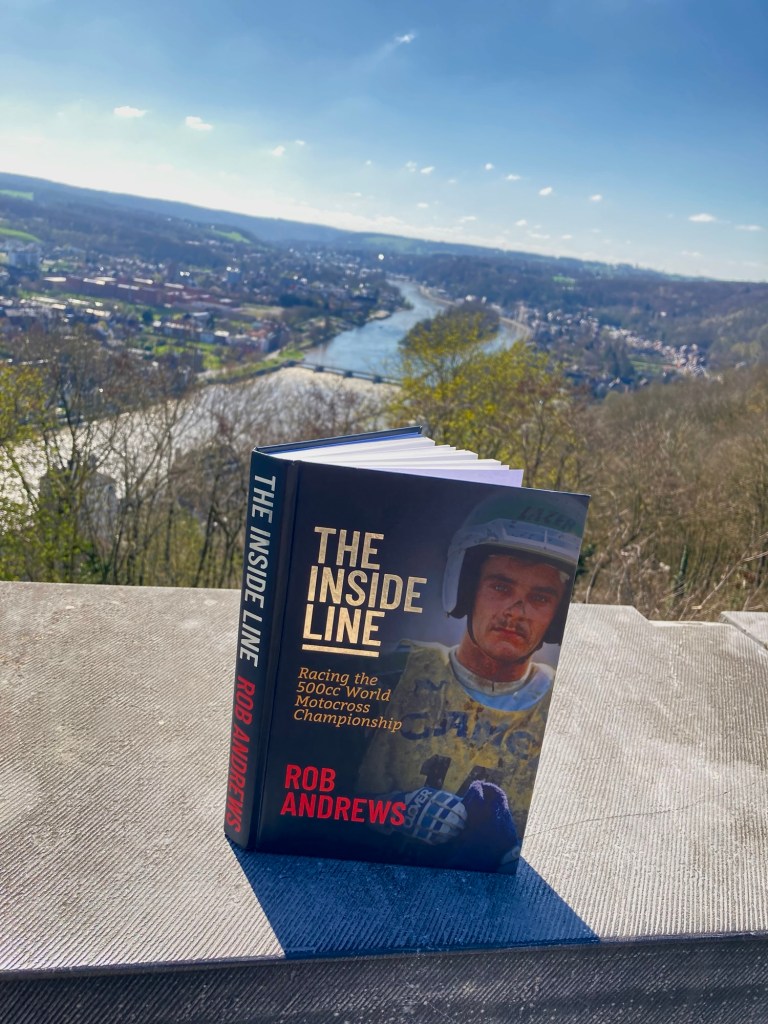
Anyone who’s ever raced at a motocross circuit that seems a bit mad when you arrive for the first time would surely relate, and I did.
In recent years, I’ve developed a habit of running. Starting with jogging around the local roads in Shrewsbury, I became a regular at the weekly 5k parkrun events, before doubling the distance and trying a few 10k events. After a little research on the internet, I found out that a half-marathon had recently started at Namur. What a place to go for the new challenge! And whilst I never watched a Grand Prix at the Citadel, I could say I’ve raced at Namur (kind of!) And of course, take some time afterwards to finally see the Citadel for myself.
Upon researching my trip, I discovered that in recent years efforts have been made to preserve the history of the Namur motocross track. Next to the Panorama cafe near the old finish line, a memorial garden had been created, including history boards detailing the history of the venue, with a track-walk also created to experience the venue first-hand.
I drove to Namur with my dad, who was along for moral support and like me, also wanted to see the old Grand Prix track for himself. The city seemed familiar to someone originating from Shropshire and used to old riverside towns. There in all their glory were the famous walls of the Citadel, standing proudly above the carpark I’d found early on Sunday morning. I was certainly looking forward to my track experience, planned for the next day.
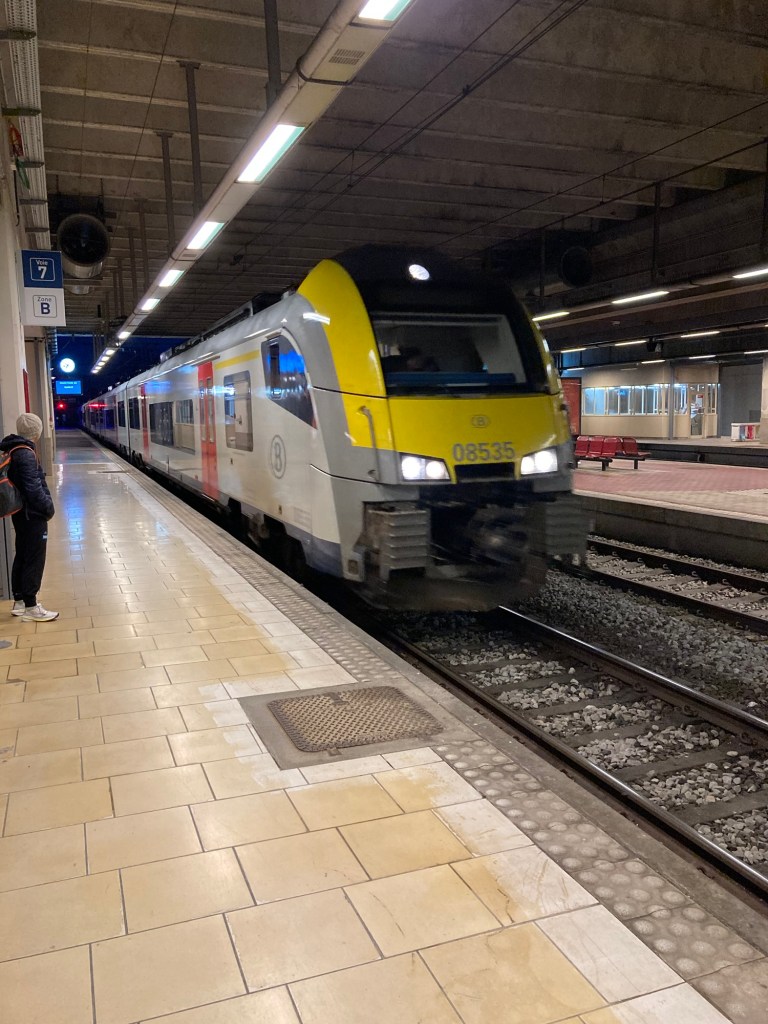
The half marathon itself did not go up to the Citadel (perhaps fortunately!) After collecting my race number from the town square, I made my way with thousands of others to the local railway station where a chartered train would take us to the start, down the Meuse river at the nearby village of Profondeville.
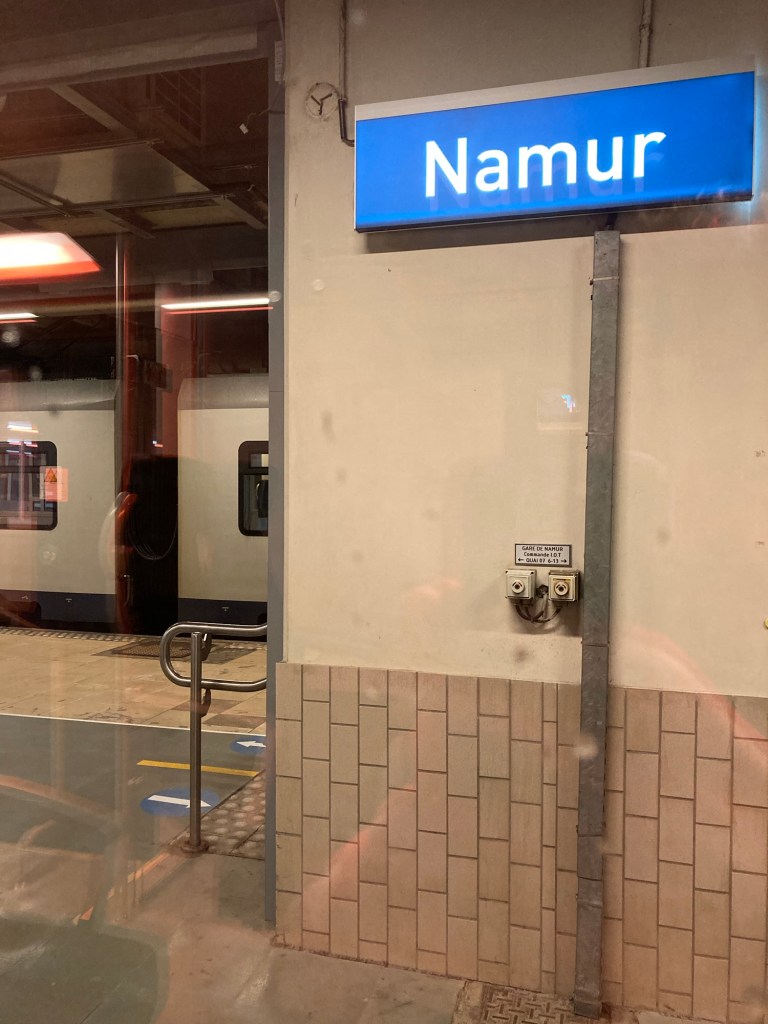
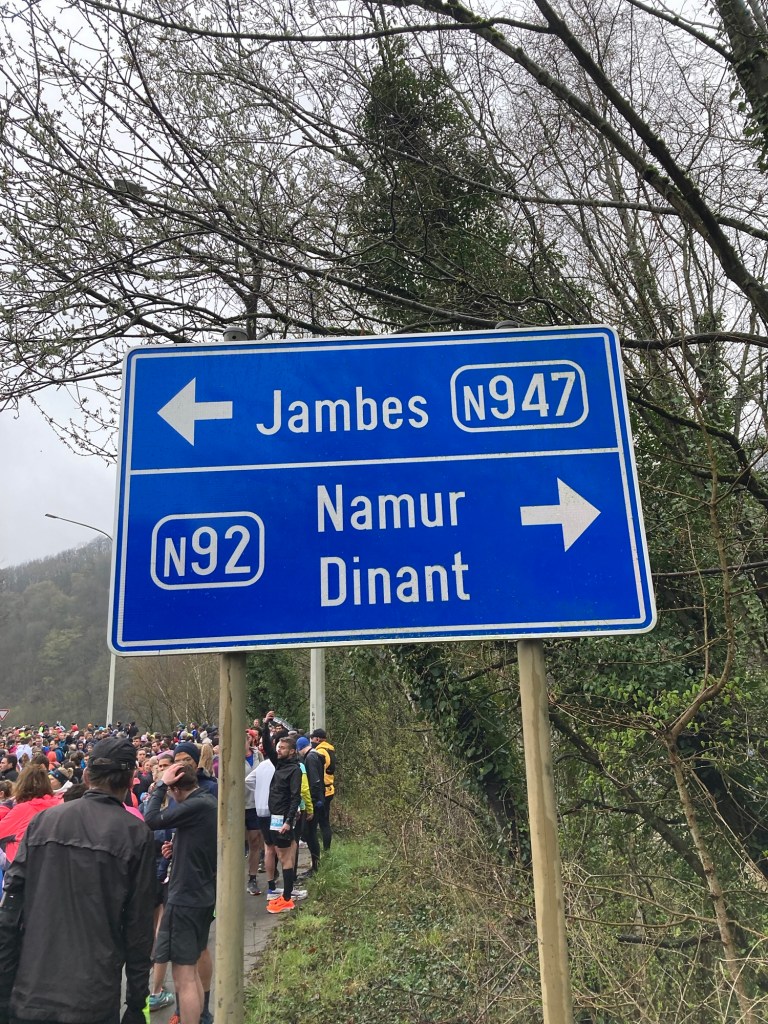
From there the race would take several miles up the river, past the Citadel, before heading out of Namur. Turning 180 degrees over the river, we would run back towards the Citadel, looping through the city streets before reaching the finish near the city square.
As daylight broke, it was a miserable spring morning, rain, with ice cold winds – my introduction to European athletics being sheltered under a flyover waiting for the race to start! It’s the combination of weather I positively hate running in, but hey. Rain didn’t stop Georges Jobe and company back in 1987, so it was time to grit my teeth and get on with it.
I was able to finish the half marathon in what I felt was a respectable time of 2 hours 20. The final part of the run was especially satisfying, looking across and seeing a peek of the famous Chalet du Monument roadside bar during the final couple of miles. And from a geek point of view, I ran past spectator lined barriers to the finish, with advertising hoardings for the same organisations such as La Meuse newspaper, that once lined the motocross track.
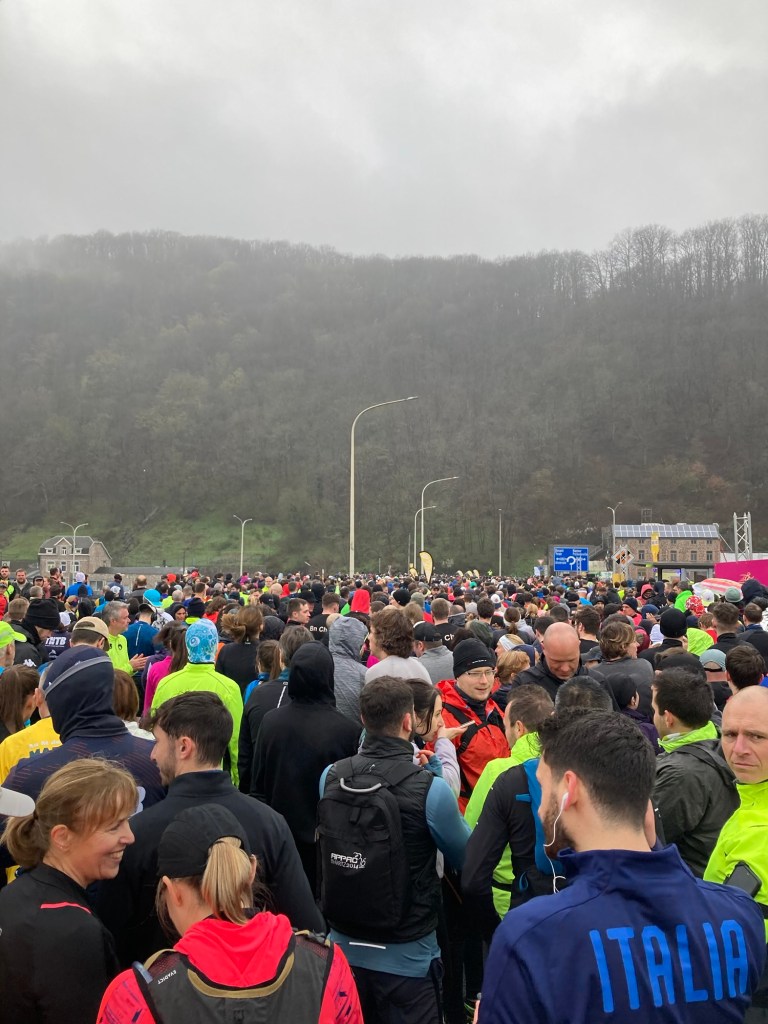
Ambience at Profondeville pre-start
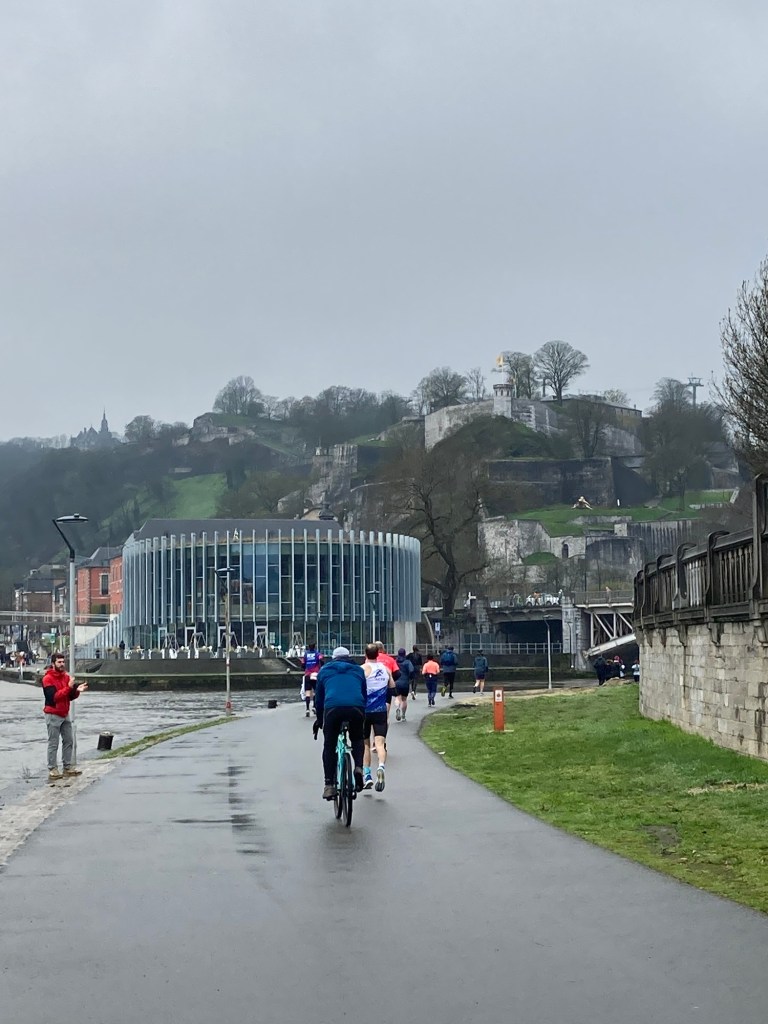
Heading back towards the Citadel after 15 kilometers
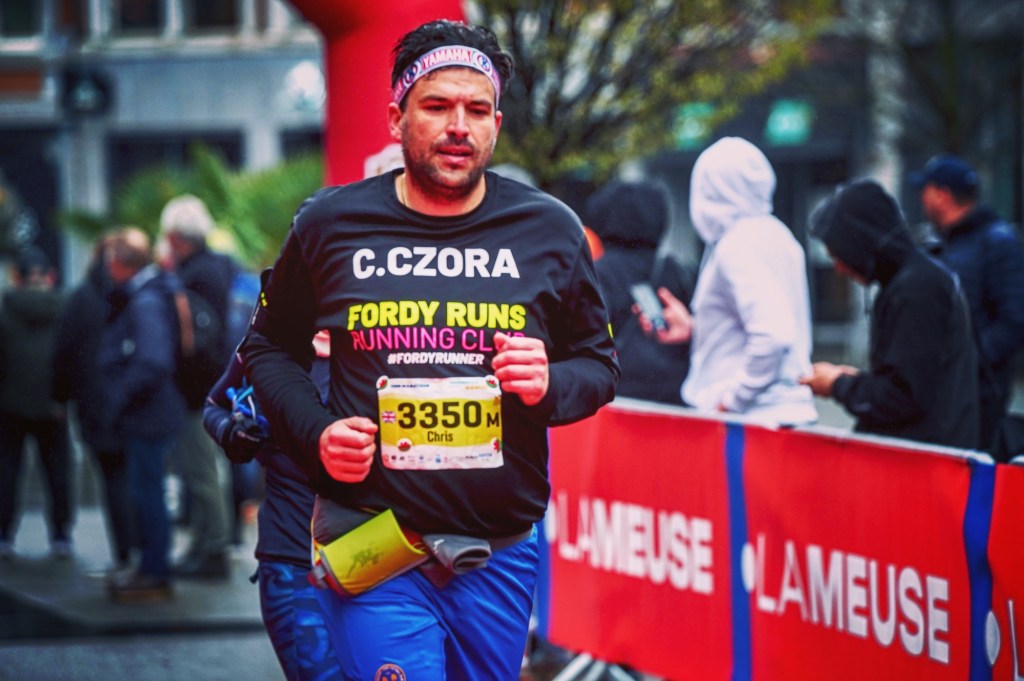
Closing in on the finish
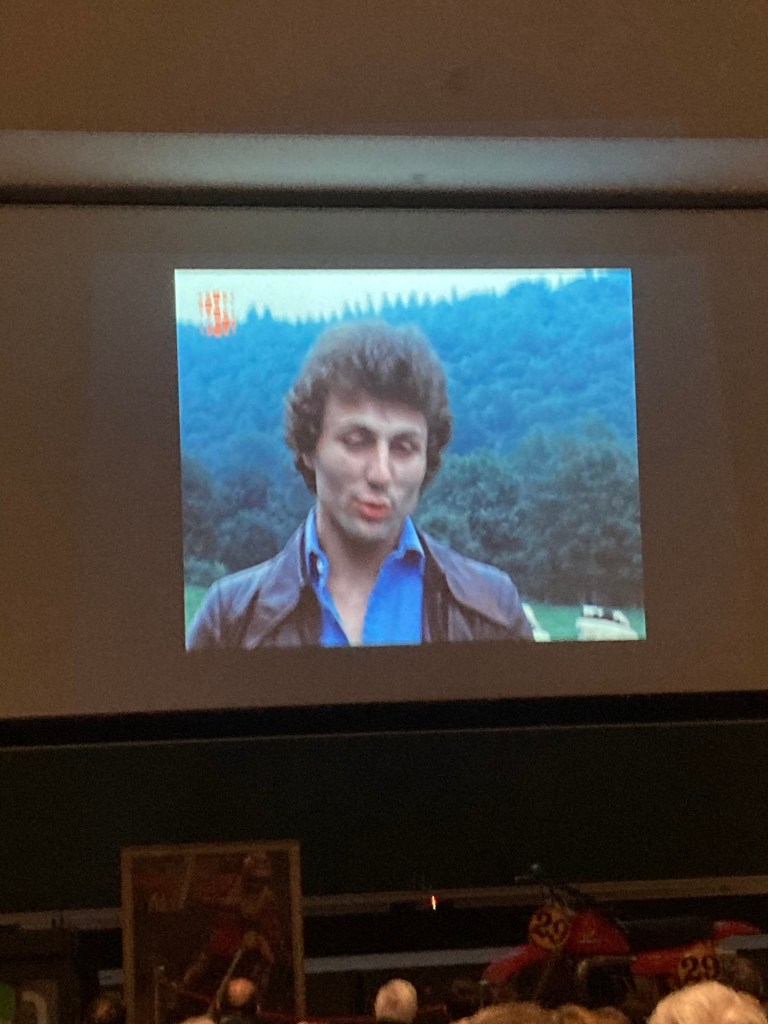
Following the race, we were lucky enough to discover an important event going on that same day. After the sad passing of Andre Malherbe last year, a film homage to his career was being shown at the local university auditorium, with talks from people who knew him well. This was entirely in French, and with a Del-Boy grasp of the language we of course would not get the full effect. But it was good to go along and pay our respects. Coupled with the films, was Malherbe’s 1980 works Honda, with posters celebrating his championship wins. There were a couple of famous riders in attendance, with Sylvain Geboers and Jean-Claude Laquaye offering their memories to the audience.
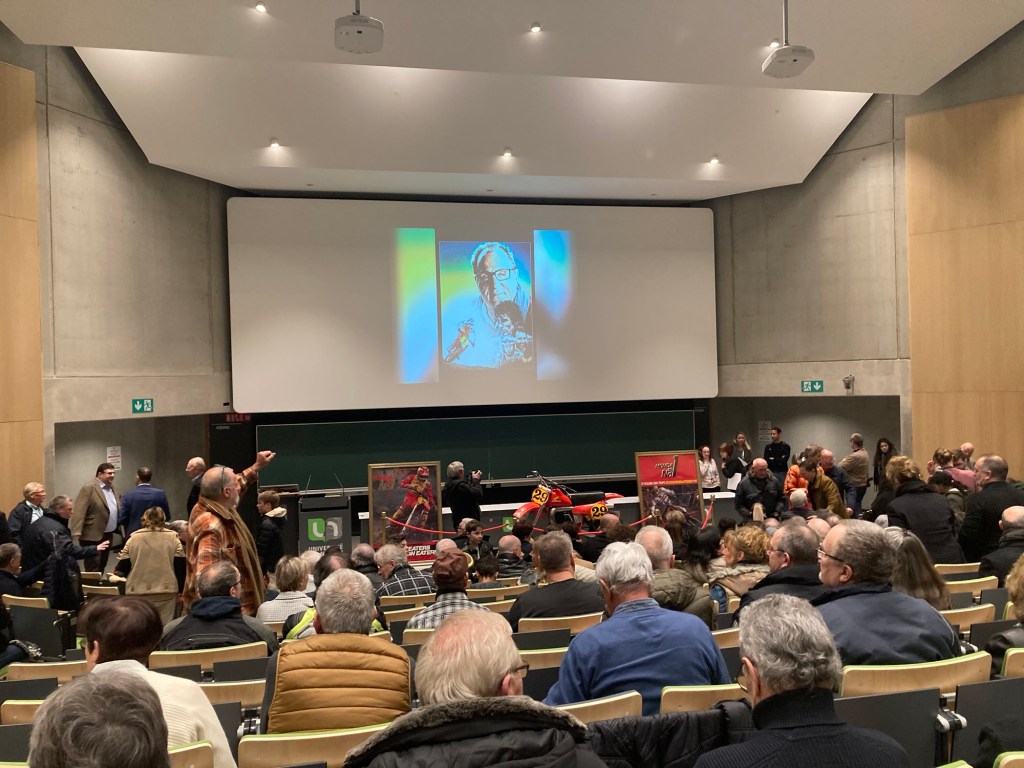
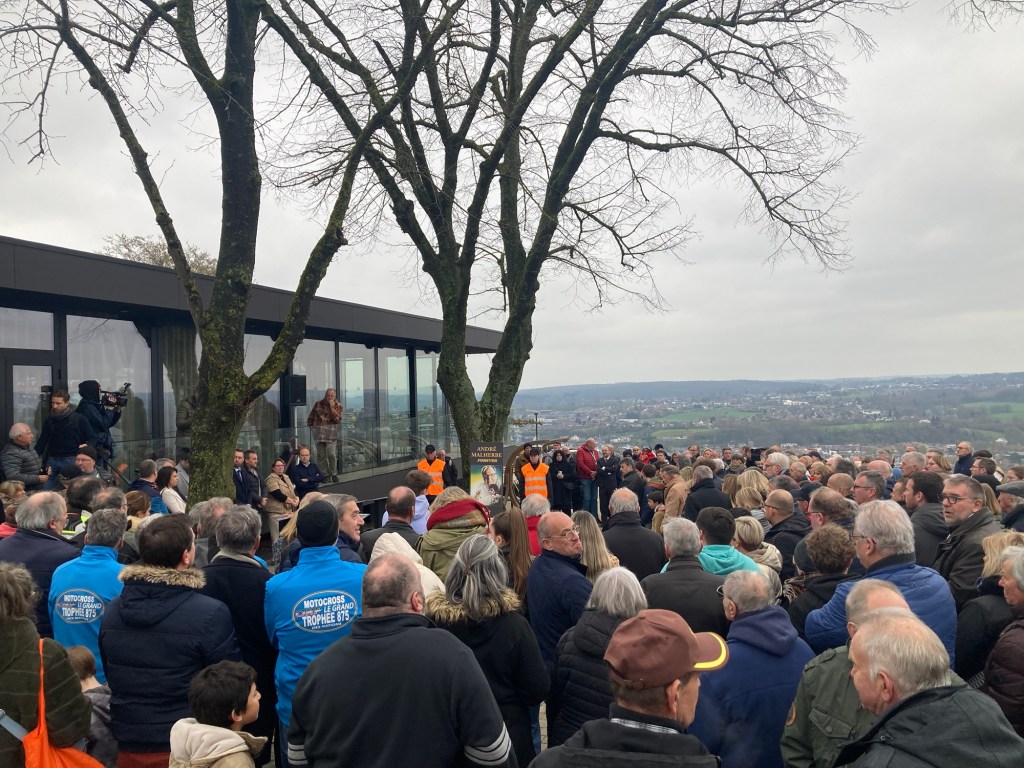
We took our first visit to the course via the recently re-opened cable car, where we stood and watched as Malherbe’s ashes were ceremonially scattered at the new memorial garden, just yards from the Namur finishing line.
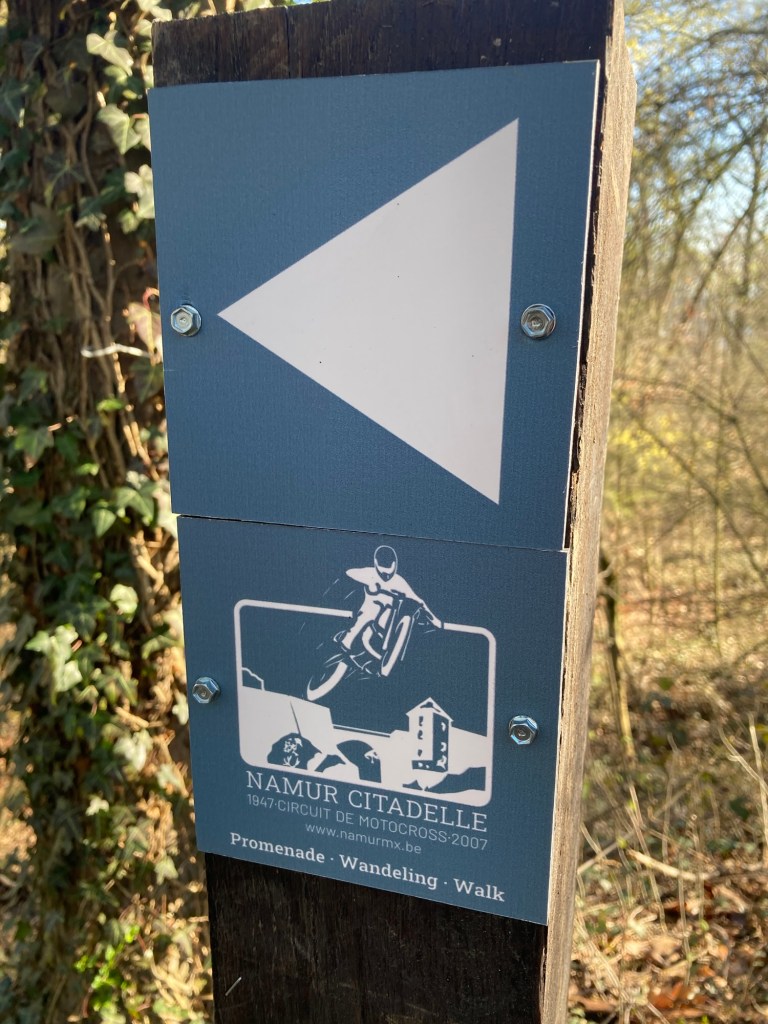
Feeling in surprisingly good shape the day after the race (maybe the obligatory Jupiler pilsner helped on Sunday night), we went for the Namur experience. Having heard about the recently created track-walk, I had picked up a leaflet from the city tourist office providing a potted history of the Namur track, along with a map from which we could experience the track for ourselves.
The walk doesn’t follow the track layout verbatim. Some of the tight corners in the woodland are very much overgrown and impossible to walk through – it would also be a health and safety nightmare to send members of the public walking up some of the more extreme parts of the track! However it’s very close to the circuit layout and allows you to get an idea of how the circuit ran, even as a newcomer.
From the edge of the city centre we drove up a narrow hillside road, through leafy parkland as we experienced our first landmark, the Chalet du Monument. It’s long ceased trading as a bar, and is now an architect’s office. The beer garden that once was crammed with beer-swilling motocross fans, now contained an array of commuters’ cars, the occupants within the office space perhaps unaware of the past significance of their rather rustic looking workplace.
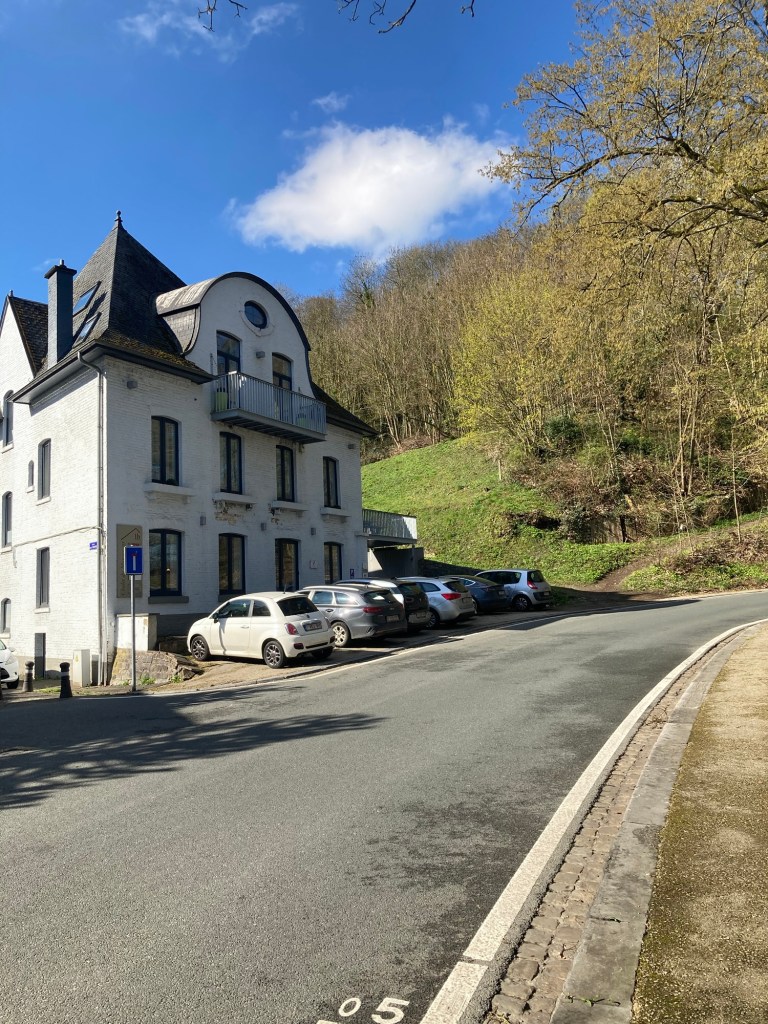
Former Chalet du Monument bar. Fans would pack out the beer garden where the cars are now parked, and adjoining footpaths. The riders would be racing towards you if stood here, emerging from what is now a small dirt path to the top right of this image. Up until the final decade, the riders raced along the tarmac road.
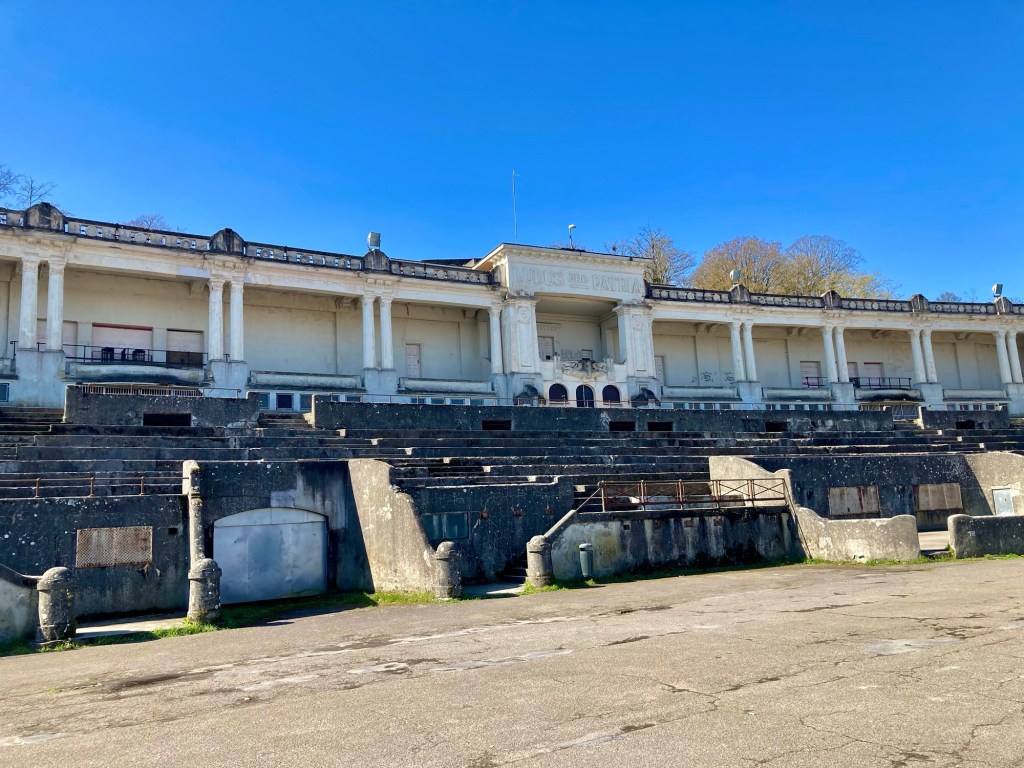
Upwards we drove, recognising little snippets of land that we’d seen on the glorious old racing videos. Before long we’d reached the summit, parking at the ‘Esplanade’, the large exhibition area where the start and finish once stood, right next to one of the circuit’s most iconic landmarks – the ‘Stade des Jeux’ grandstand.
It was every bit as large and imposing as it seemed in the pictures. It certainly looked rather weathered, and a little sorry in places with graffiti marks.
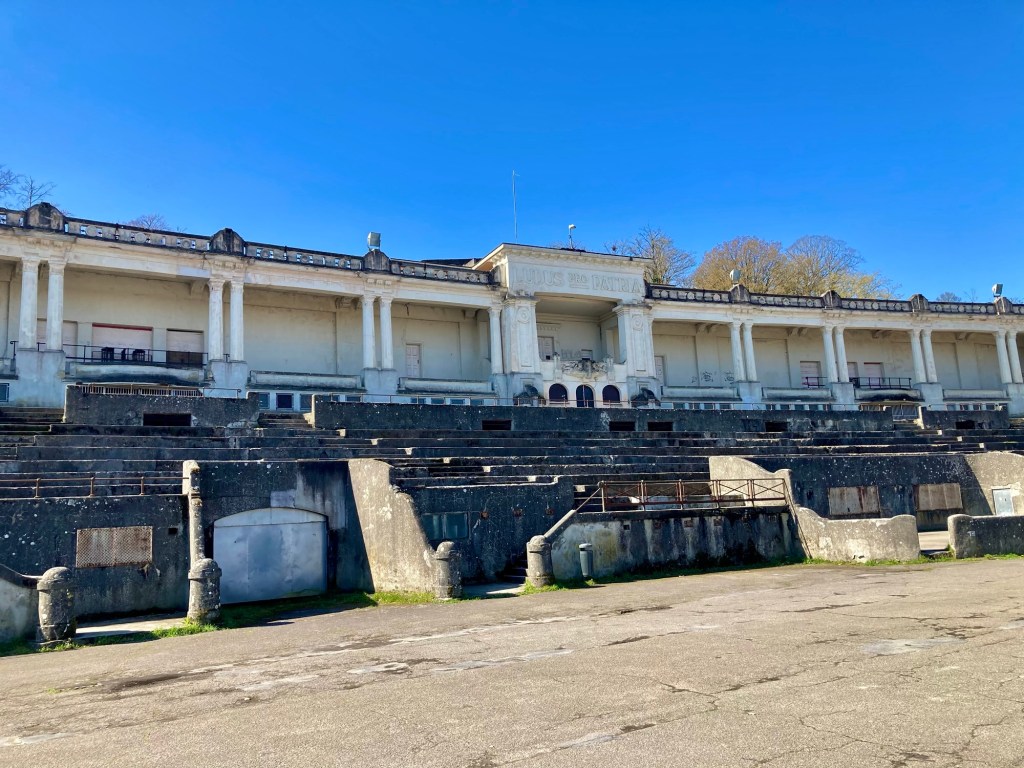
But standing there, minds were cast back to some of the key moments in motocross history. The grandstand is not particularly old (constructed around 1910) but has the appearance of a Roman coliseum, adding to the mystique, the 500cc Grand Prix stars being gladiators in one of the most notorious venues of combat. (Ed – since I initially wrote this article, a large-scale renovation project has started to bring the Stade des Jeux back to its old glory)
Just to the right of the grandstand, a small opening in the woods led to the opening part of the lap, a woodland plateau sweeping underneath steep grass banks on my left, which I could picture lined with fans. To the right, the city of Namur formed a backdrop, serving to illustrate how close we still were to the city.
It seemed amazing how ‘small’ the venue felt. Watching the old Grand Prix videos on YouTube, it’s easy to think of the track being in some vast woodland, in reality the venue was semi-urban and extremely compact, with spectators lining the track and congregating in vast numbers where they could.
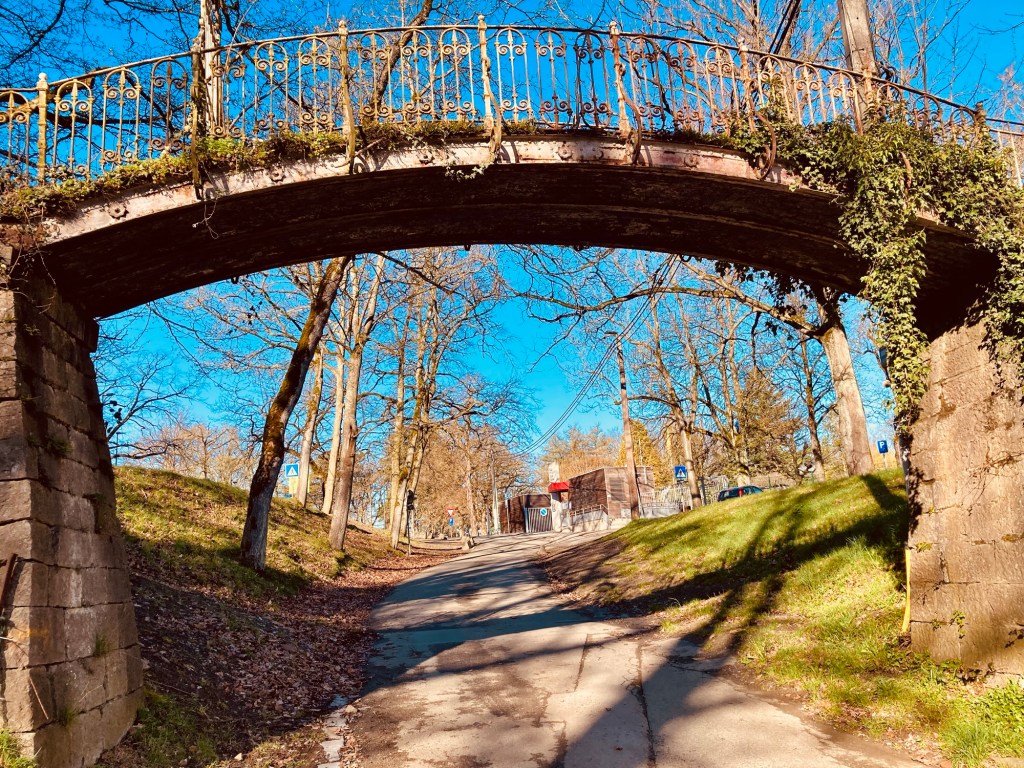
A short walk from here was one of the circuit’s first landmarks, the iconic stone pedestrian bridge, under which the riders once raced. Virtually opposite the garden and park that served as the race paddock, this iconic landmark looked very neglected and increasingly derelict, it would not be a surprise if this eventually ends up demolished. But it still served as an iconic vantage point.
One of the most fearsome parts of the circuit was the woodland step-down section. Approaching the halfway point of the lap, the track walk allowed views of this obstacle from all angles. This step down had a steep drop, bottoming out onto a flat woodland trackway, before a second shallower drop-off where the riders would immediately turn into a right hand bend.
Most riders would roll down the steep hill, however in latter years some riders would attempt to spectacularly jump down the hill, leaping from the top to land on the lower drop-off. In itself, the step-down was not particularly imposing as a potential downhill double-jump, however a few key things had to be considered. The run up to the obstacle was totally blind, even walking up it was impossible to see the track below. There was no take off ramp, and walking the course it became apparent the take off was downhill facing. Plus, the small matter of some very imposing trees lining the course on each side! It was incredible to look at the run-up, imagining going up to it as a rider, totally blind but committed to making the jump. Not to mention being a spectator at the bottom of the hill, watching some of the faster riders leaping into orbit.
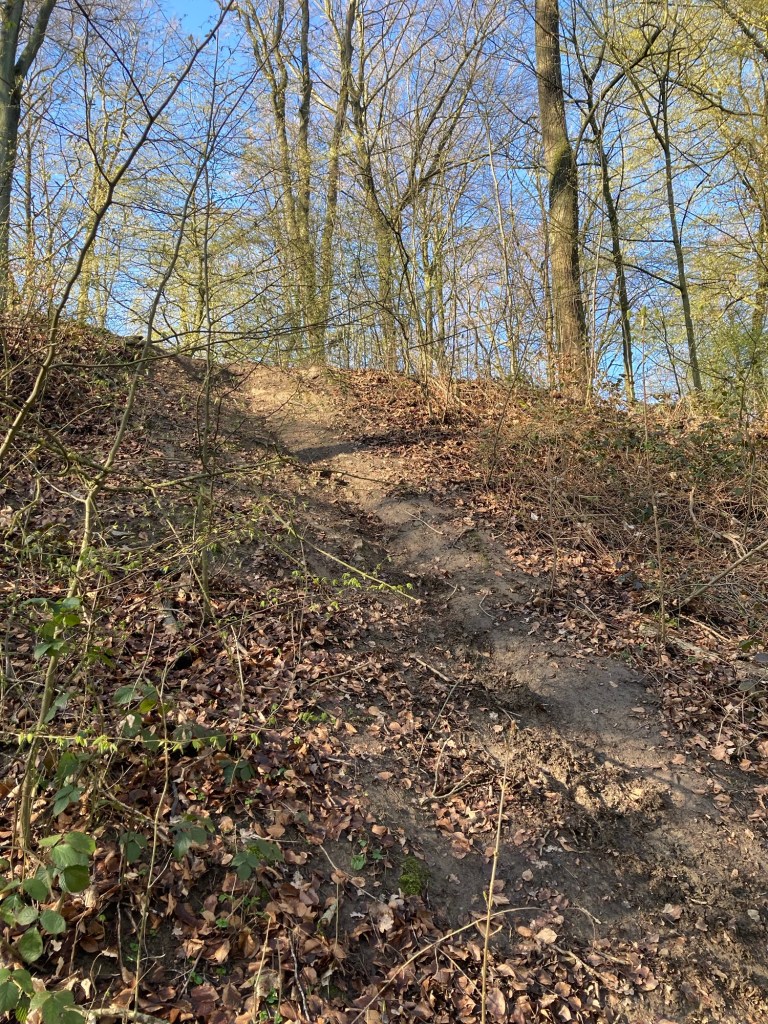
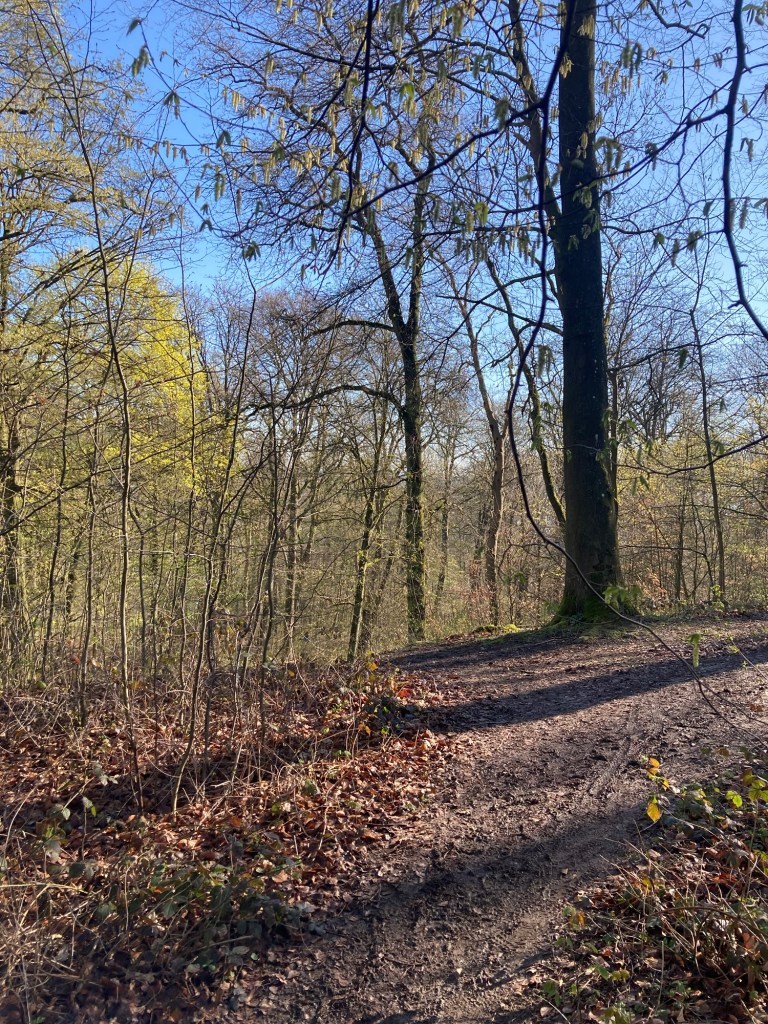
Approach to the downhill drop, completely unsighted. If committing to jumping off the hill I suppose you’d be hoping the marshals were paying attention.
The track walk was an incredible experience. It really allows the first-time visitor to get a feel for the track, and despite never being to a race in person, to imagine what it must have been like.
Walking past the famous old bar and road section, the course gradually winds back uphill towards the end of the lap, with one part being particularly fearsome.
Omitted in later years, riders would leap from a grass bank on the verges of the road section, landing onto a cobbled path, before speeding towards a sharp right hand corner that was directly in front of the fortress’ perimeter walls. On the day we walked it, this was a very narrow side lane, tourist cars squeezed onto it were possible.
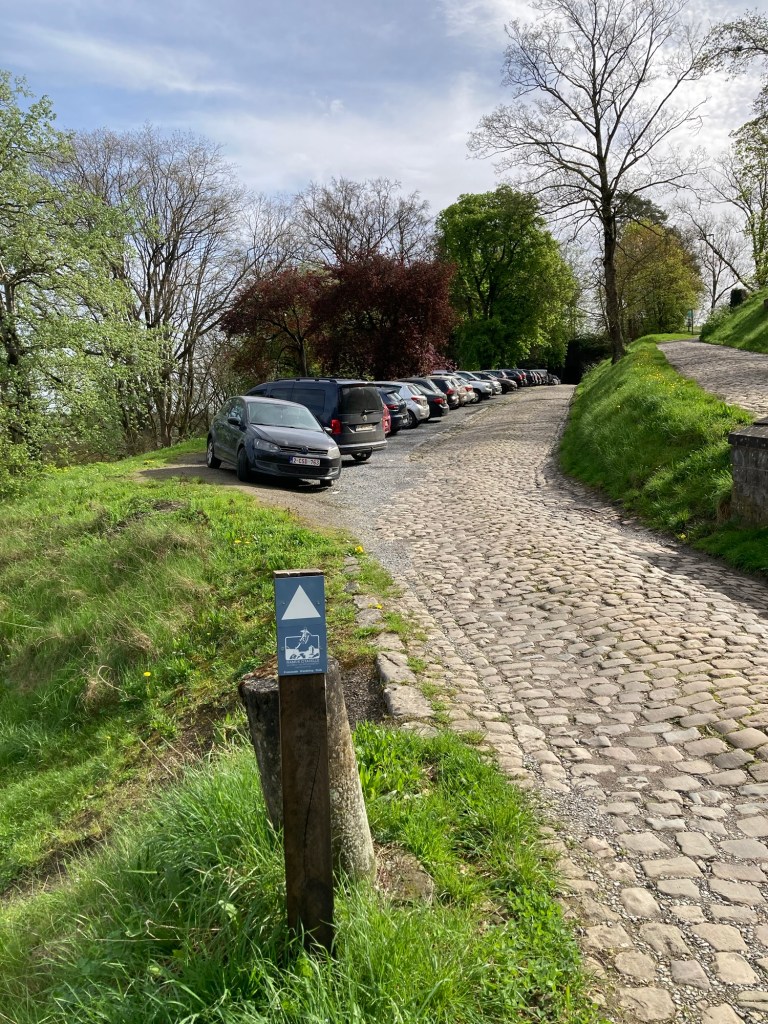
Certainly not a place you’d expect motocross riders to be racing at full speed. And having been to the likes of Hawkstone Park and Foxhill, nothing compared to the short hill directly after the corner that climbed alongside the perimeter wall for gradient. More a vertical cliff-face than a track.
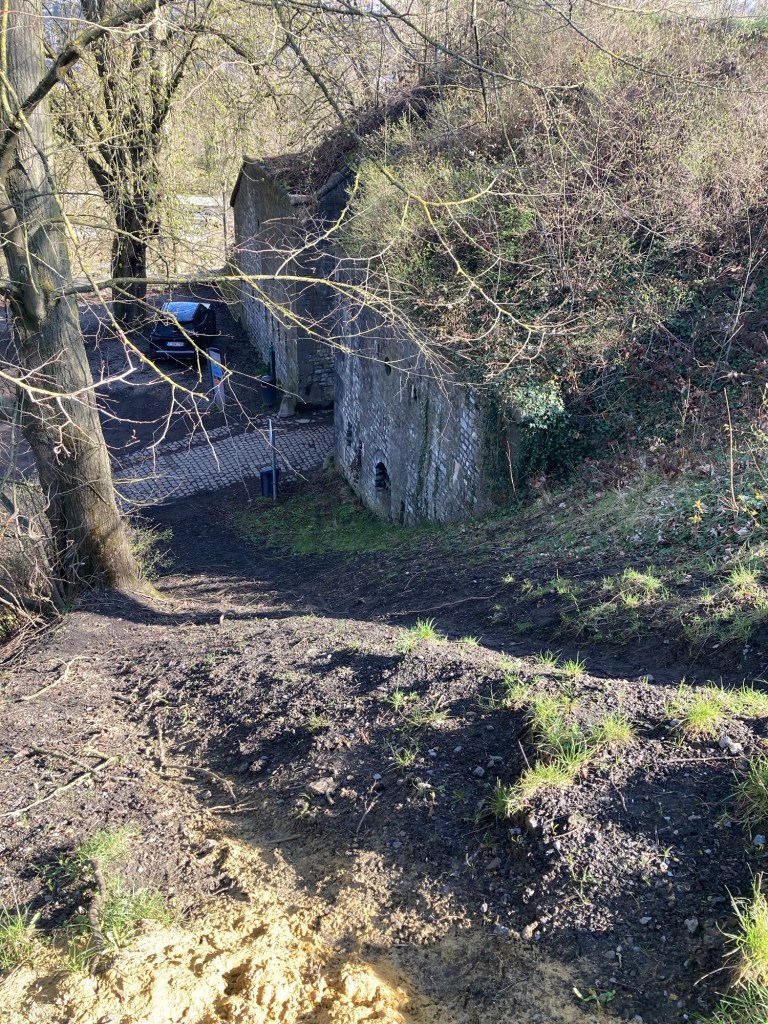
We deviated from the walk slightly to walk up the triple uphill section heading towards the top of the track. When focusing on the racing it’s easy not to notice the huge fortress moat that sits just a few feet from the former race track. Although there’s a fairly substantial wire fence to stop you straying over the edge, I’m told that fence wasn’t always there…
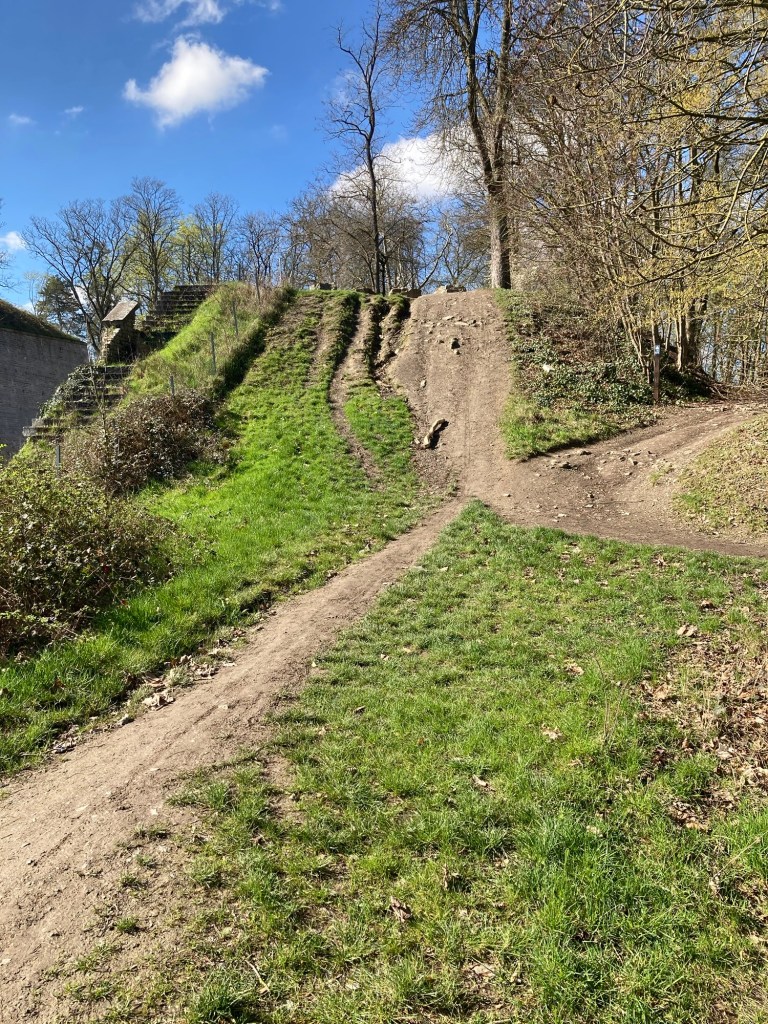
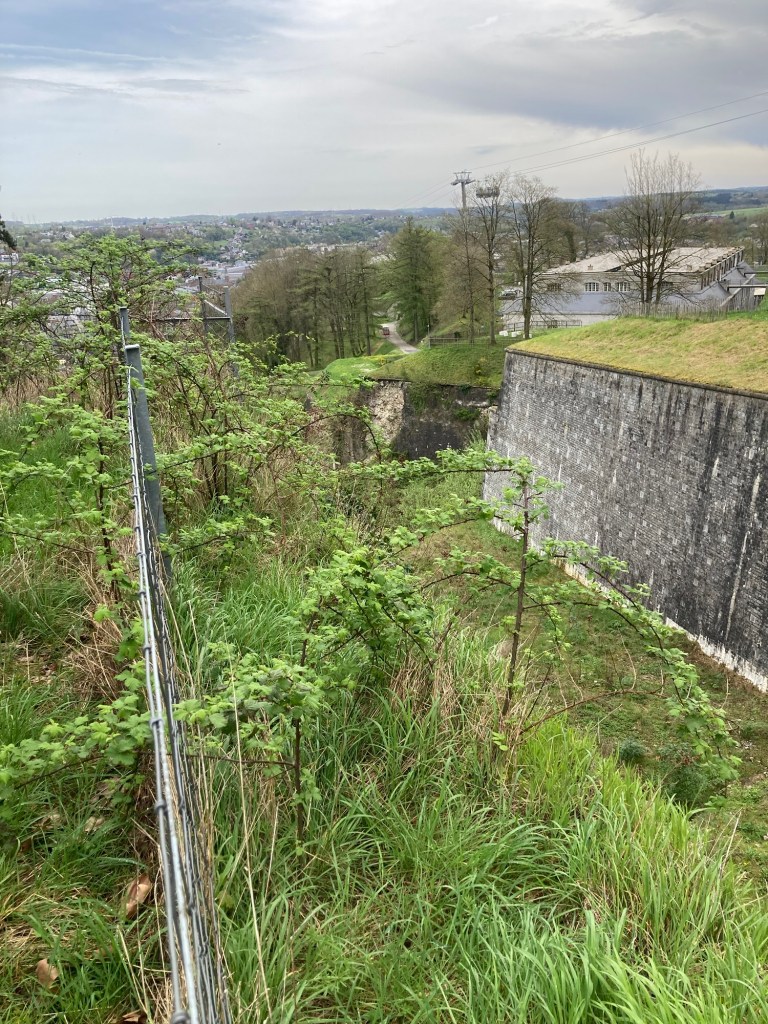
As we made the final climb to the top of the course, back into daylight and with the Stade des Jeux towering to our right, our lap was complete. At 2.5 hours, it was somewhat slower than a qualifying lap time from Thorpe or Malherbe, but that didn’t matter. We’d taken our time to really look around and get a feel of the track.
Part of what ended Namur is also part of makes it a great place to visit and experience motocross history. It’s on a national heritage site. It would (hopefully) be highly unlikely that the venue would ever be sold off to private hands and sealed away from the public. The extreme hillside nature of the site means it could never feasibly be flattened for a housing estate or storage warehouse.
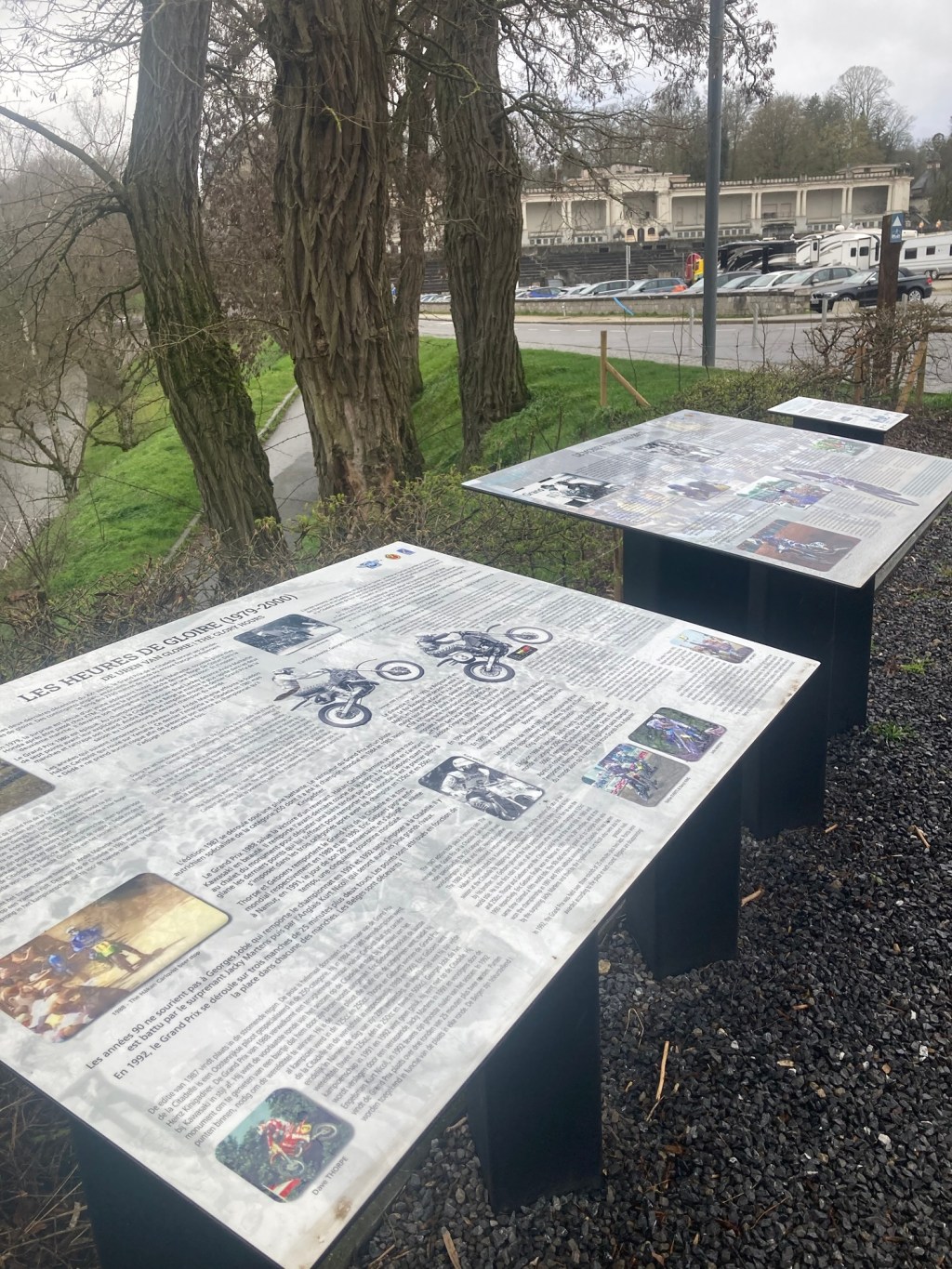
What is fantastic is the work conducted by motocross enthusiasts to preserve the history of motocross in this already historical city. The track walk starts and ends at the Panorama cafe, within sight of the Stade des Jeux and the old finish line.
Standing at that position, with the Meuse river sprawling below, and the grandstand to your right, you are in Namur and can almost smell the pre-mix fuel, the Jupiler beer and the fried frites and mayonnaise.
Preserved for generations to follow is a history of what occurred on this otherwise sleepy little corner of the city, with memorials to past riders who made history.
If you never went to a Grand Prix at Namur, fear not – it’s still there. It looks a little more normal today, and certainly a lot more overgrown, but you can still get a flavour of what it was about and why it’s still revered by so many as the ultimate Grand Prix venue.
POST-ADDENDUM
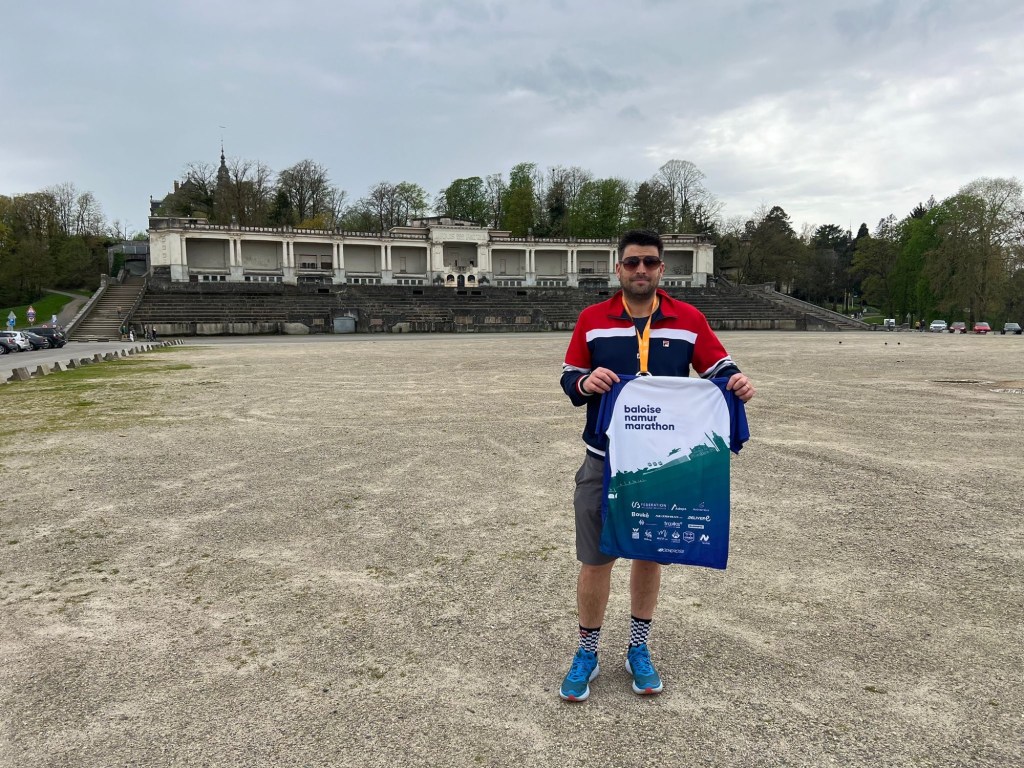
Since writing this article I have returned to Namur once more for the half marathon, in 2024. This time I was accompanied by my wife Deneale, who competed in the Namur 10k race which took place simultaneously.
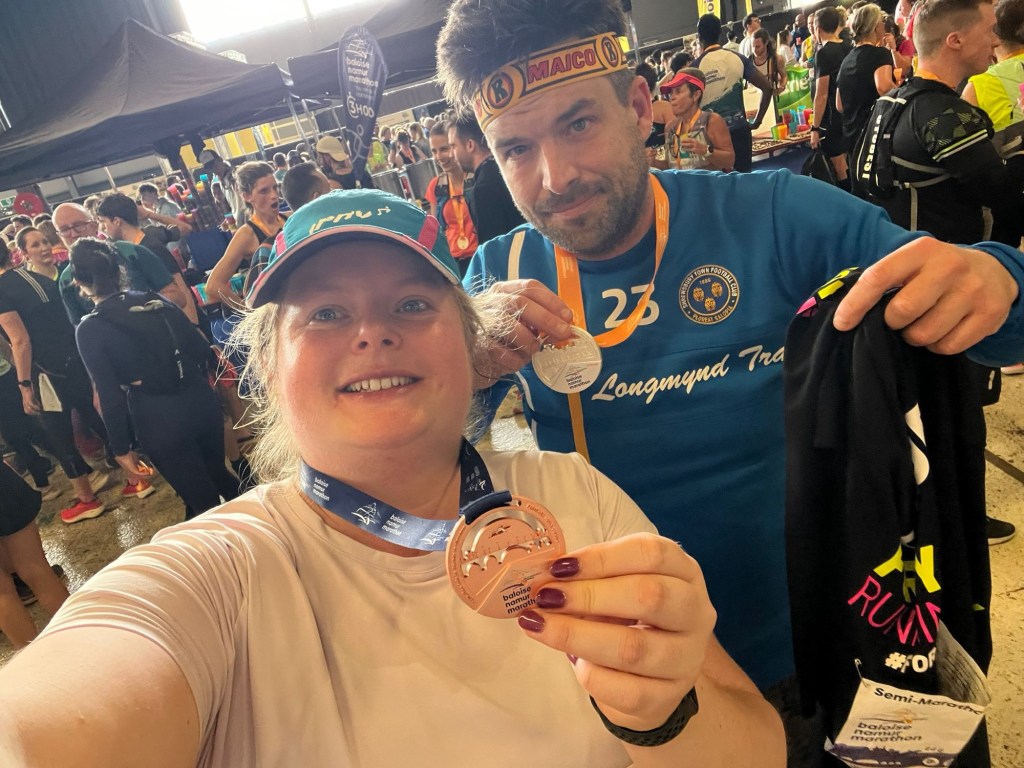
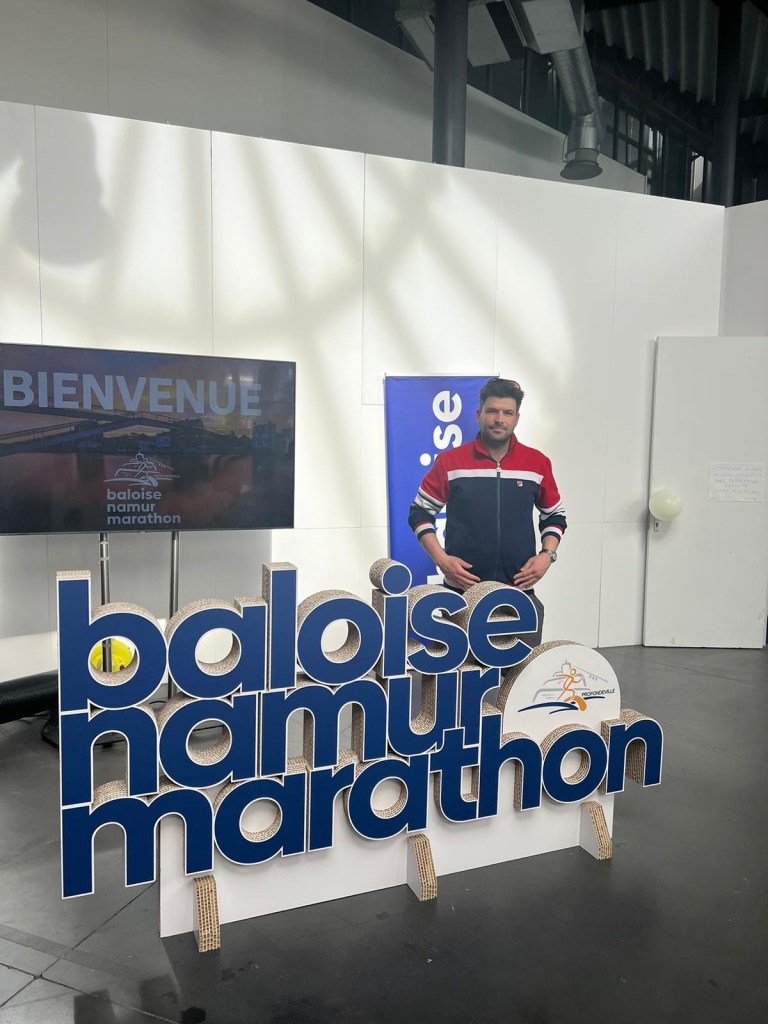
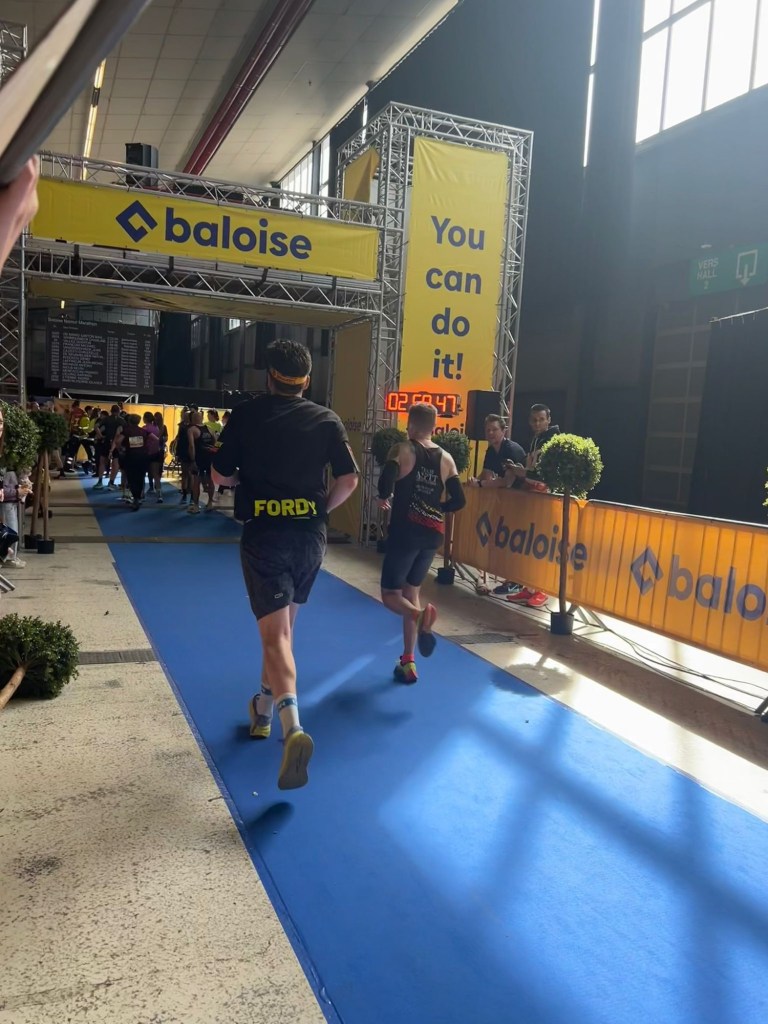
This time the weather was far nicer, warm spring weather made the event much more enjoyable. Perhaps though, the warmer weather made things harder and after a strong start I ended up a minute slower than 2023. Mind you, I did enjoy the layout a bit more, the finish being amended to finish at the Namur Expo centre just outside of the city centre. Although this missed out the excellent run through the city centre streets, it did run alongside the Sambre river, very close to the Citadel.
Oddly, the actual finish was in the Expo itself, with the last 20 metres or so being indoors. It certainly made things very hot and stuffy being packed with finishing runners and the spectators, although the free glass of strong Belgian beer courtesy of event sponsors Chimay certainly went down well!
The previous day’s event registration, also at the Expo, also unearthed another hidden gem of Namur history. Standing on the footpath opposite the building was a statue of AC/DC frontman Brian Johnson.
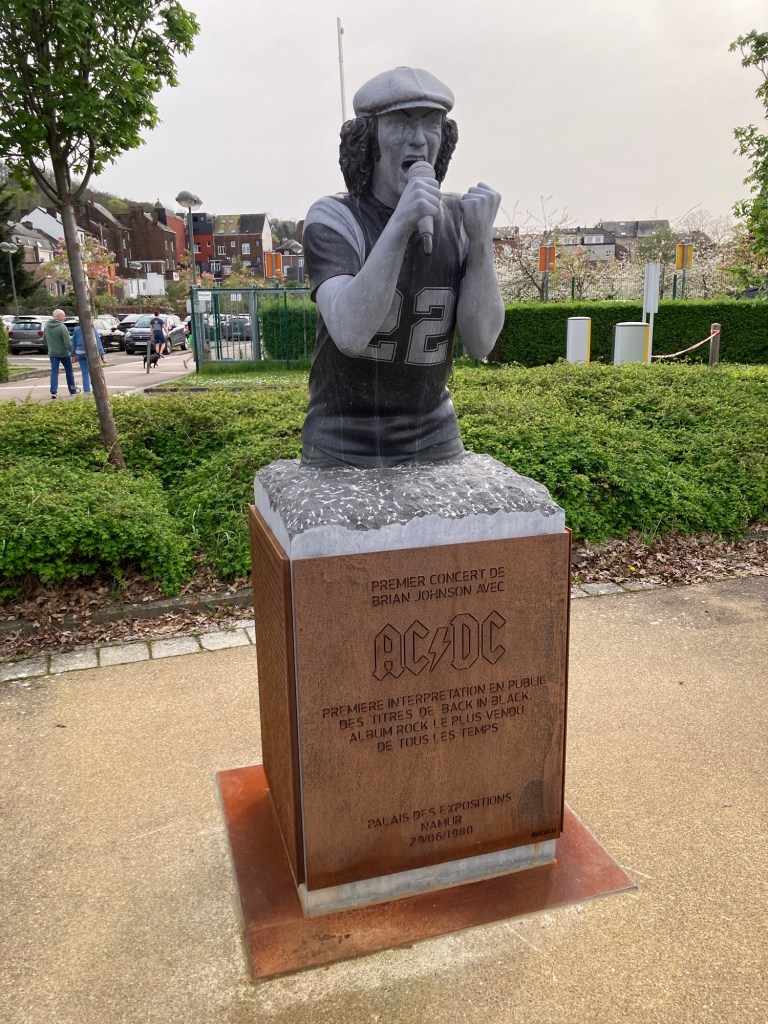
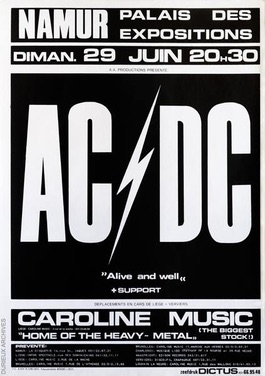
It turns out that following the untimely death of frontman Bon Scott in 1980, and the subsequent recruitment of Brian Johnson, the band started it’s ‘Back in Black’ tour in June 1980 at Namur, the Expo serving as the first ever AC/DC concert with the new lineup, the ‘Back in Black’ album subsequently becoming the second highest selling album in history. Much like the motocross, another hidden history gem of this city!
I haven’t been to Namur since, but hope to return for the half marathon very soon, and represent my new club Daventry Road Runners at the legendary Citadel!
NOTES:Andrews – Rob Andrews MX
If you’re interested in seeing motocross’s version of Brigadoon for yourself, it’s all very easy. Namur is well situated between Brussels and Liege, and is well served for motocross fans travelling to events in central Europe. It has good rail links and plentiful accommodation for all budgets. You can pick up a leaflet for the Namur track walk from the Namur tourism office next to the city’s railway station, or from the foyer at the Panorama cafe, situated on the Esplanade.